


Salt Lake City, Utah
Salt Lake City, Utah
Salt Lake City, Utah
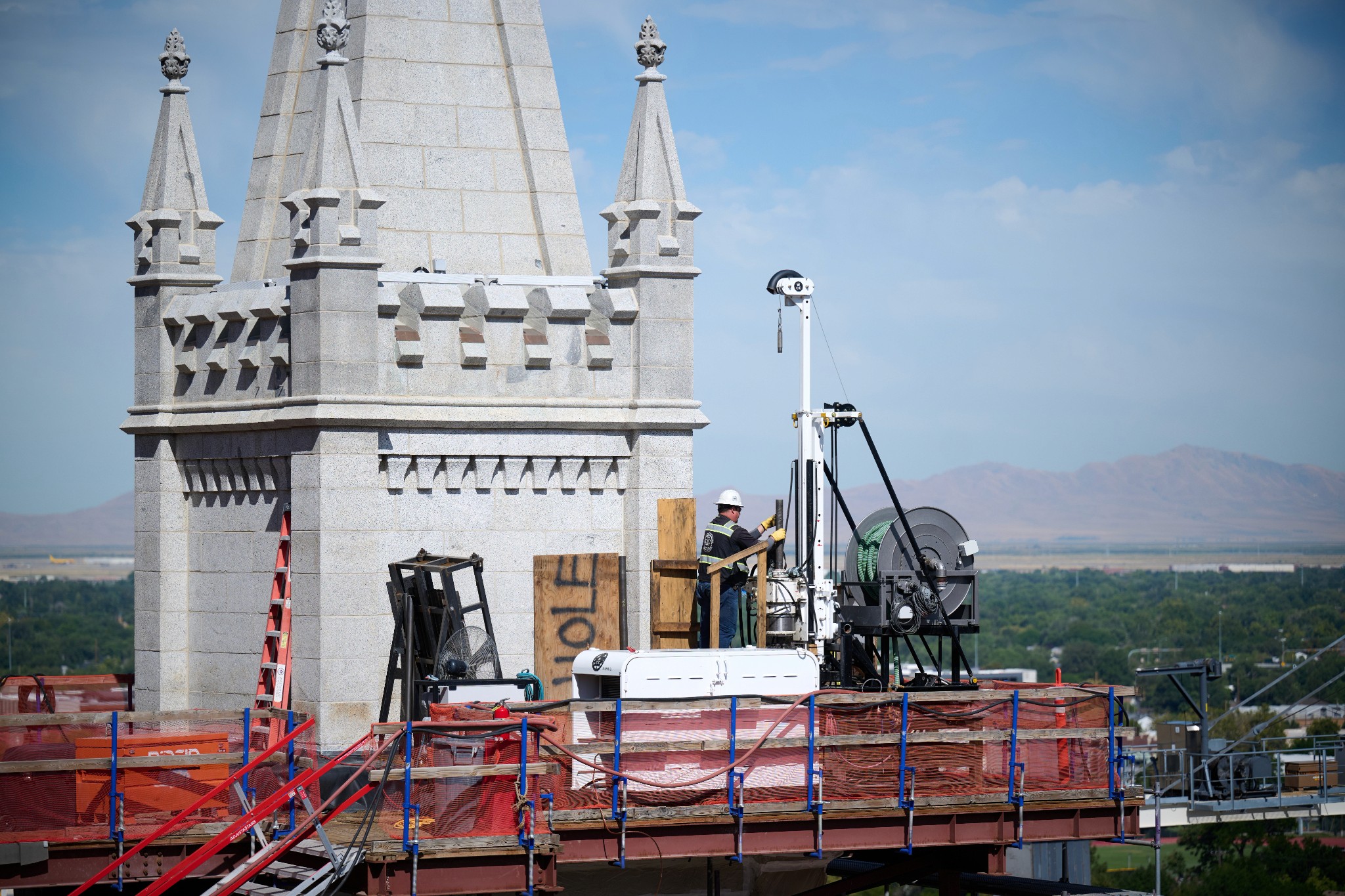
The Salt Lake Temple seismic retrofit required excavation, underpinning, and replacement of the temple’s foundation with a new base-isolation system beneath a 185-million-pound, pre-code unreinforced masonry landmark. The work took place in a constrained downtown setting, above an active fault, while adjacent facilities remained occupied—creating unusually high consequences for even subtle structural or ground movement.
Measure conceived, designed, and operated a six-year geotechnical and structural monitoring program to give the owner, designers, architect, and contractor a continuous view of how the temple, surrounding soils, and adjacent facilities responded to construction. The program remained active through the 2020 Magna magnitude 5.7 earthquake as construction was underway.
The Salt Lake Temple seismic retrofit required excavation, underpinning, and replacement of the temple’s foundation with a new base-isolation system beneath a 185-million-pound, pre-code unreinforced masonry landmark. The work took place in a constrained downtown setting, above an active fault, while adjacent facilities remained occupied—creating unusually high consequences for even subtle structural or ground movement.
Measure conceived, designed, and operated a six-year geotechnical and structural monitoring program to give the owner, designers, architect, and contractor a continuous view of how the temple, surrounding soils, and adjacent facilities responded to construction. The program remained active through the 2020 Magna magnitude 5.7 earthquake as construction was underway.
The Salt Lake Temple seismic retrofit required excavation, underpinning, and replacement of the temple’s foundation with a new base-isolation system beneath a 185-million-pound, pre-code unreinforced masonry landmark. The work took place in a constrained downtown setting, above an active fault, while adjacent facilities remained occupied—creating unusually high consequences for even subtle structural or ground movement.
Measure conceived, designed, and operated a six-year geotechnical and structural monitoring program to give the owner, designers, architect, and contractor a continuous view of how the temple, surrounding soils, and adjacent facilities responded to construction. The program remained active through the 2020 Magna magnitude 5.7 earthquake as construction was underway.

Monitoring Approach and System Deployment
The monitoring program combined structural, geotechnical, and environmental measurements in a single real-time data platform. Robotic total stations tracked survey prisms at critical locations on the temple, providing high-precision measurements of movement as excavation, underpinning, parapet removal, load-transfer work, and base-isolator installation progressed. Tiltmeters monitored rotation in the tower complexes, while crackmeters measured deflection in real time.
The deployed system also incorporated vibrating-wire instrumentation and other geotechnical sensors to track the response of the historic masonry, surrounding soils, and foundation work. At peak construction, the program operated up to 3,000 sensors. This scale enabled the team to observe both local effects—such as changes near temporary support or excavation activity—and the broader response of the structure and site.
Site-characterization monitoring added perimeter seismometers with triaxial geophones and microphones to establish baseline vibration and sound levels from normal roadway and construction-adjacent activity. Weather sensing provided temperature, wind, and precipitation data, helping the team interpret whether measured movement reflected environmental conditions or construction-related behavior.
All instrumentation was connected to a secure, cloud-based data platform. Authorized project participants could view data in real time through a web browser, receive text or email notifications when measurements exceeded established thresholds, and access tabular data for engineering analysis and model validation.
Monitoring Approach and System Deployment
The monitoring program combined structural, geotechnical, and environmental measurements in a single real-time data platform. Robotic total stations tracked survey prisms at critical locations on the temple, providing high-precision measurements of movement as excavation, underpinning, parapet removal, load-transfer work, and base-isolator installation progressed. Tiltmeters monitored rotation in the tower complexes, while crackmeters measured deflection in real time.
The deployed system also incorporated vibrating-wire instrumentation and other geotechnical sensors to track the response of the historic masonry, surrounding soils, and foundation work. At peak construction, the program operated up to 3,000 sensors. This scale enabled the team to observe both local effects—such as changes near temporary support or excavation activity—and the broader response of the structure and site.
Site-characterization monitoring added perimeter seismometers with triaxial geophones and microphones to establish baseline vibration and sound levels from normal roadway and construction-adjacent activity. Weather sensing provided temperature, wind, and precipitation data, helping the team interpret whether measured movement reflected environmental conditions or construction-related behavior.
All instrumentation was connected to a secure, cloud-based data platform. Authorized project participants could view data in real time through a web browser, receive text or email notifications when measurements exceeded established thresholds, and access tabular data for engineering analysis and model validation.
Monitoring Approach and System Deployment
Monitoring Approach and System Deployment
The monitoring program combined structural, geotechnical, and environmental measurements in a single real-time data platform. Robotic total stations tracked survey prisms at critical locations on the temple, providing high-precision measurements of movement as excavation, underpinning, parapet removal, load-transfer work, and base-isolator installation progressed. Tiltmeters monitored rotation in the tower complexes, while crackmeters measured deflection in real time.
The deployed system also incorporated vibrating-wire instrumentation and other geotechnical sensors to track the response of the historic masonry, surrounding soils, and foundation work. At peak construction, the program operated up to 3,000 sensors. This scale enabled the team to observe both local effects—such as changes near temporary support or excavation activity—and the broader response of the structure and site.
Site-characterization monitoring added perimeter seismometers with triaxial geophones and microphones to establish baseline vibration and sound levels from normal roadway and construction-adjacent activity. Weather sensing provided temperature, wind, and precipitation data, helping the team interpret whether measured movement reflected environmental conditions or construction-related behavior.
All instrumentation was connected to a secure, cloud-based data platform. Authorized project participants could view data in real time through a web browser, receive text or email notifications when measurements exceeded established thresholds, and access tabular data for engineering analysis and model validation.
Project Value
The program turned a high-risk construction environment into a measurable, manageable process. Instead of relying on analytical predictions alone, the project team used observed structural and geotechnical data to validate modeling assumptions, refine construction sequencing, and adjust temporary support measures based on the temple’s actual response. Real-time monitoring enabled the team to investigate small, unexpected trends before conditions escalated. That capability supported decisions about protecting the temple’s historic stone fabric and finishes while allowing the project to proceed through deep excavation, underpinning, and installation of 98 base isolators.
This monitoring system created a documented basis for long-term stewardship. The methodology demonstrated at the Salt Lake Temple has since been applied to monitor 650 historic structures for a private client on a UNESCO World Heritage Site.
The program turned a high-risk construction environment into a measurable, manageable process. Instead of relying on analytical predictions alone, the project team used observed structural and geotechnical data to validate modeling assumptions, refine construction sequencing, and adjust temporary support measures based on the temple’s actual response. Real-time monitoring enabled the team to investigate small, unexpected trends before conditions escalated. That capability supported decisions about protecting the temple’s historic stone fabric and finishes while allowing the project to proceed through deep excavation, underpinning, and installation of 98 base isolators.
This monitoring system created a documented basis for long-term stewardship. The methodology demonstrated at the Salt Lake Temple has since been applied to monitor 650 historic structures for a private client on a UNESCO World Heritage Site.

If you have questions about monitoring or it showed up in your scope and you're looking for solutions, call (909) 809-5559 or fill out the form.
Request a Quote